Rat Droppings: What Do They Look Like? Identification Guide
Practical information for UK homeowners. Check product labels and follow current safety guidance.
Finding droppings around your home can be unpleasant, especially when you are unsure which pest has left them.
Rat droppings can provide an important clue when investigating rodent activity. However, their appearance can vary, and droppings alone should not be used to confirm the species.
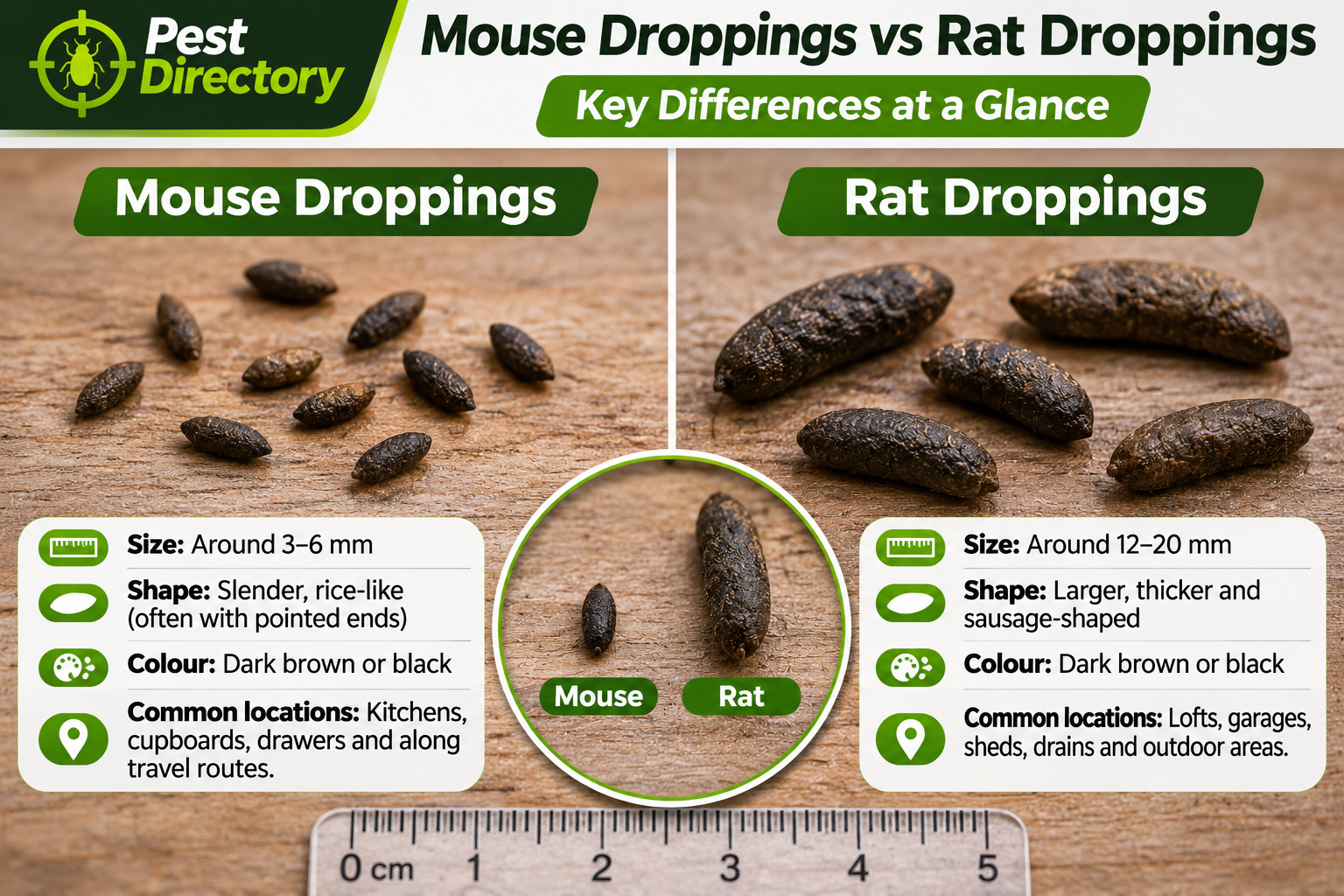
What do rat droppings look like?
Brown rat droppings are generally dark brown or black and elongated.
They are usually noticeably larger than mouse droppings. Fresh droppings may appear darker and moist, while older droppings can become dry and brittle.
Their appearance can change depending on the animal’s diet and the age of the droppings.
Where might you find rat droppings?
Look for evidence in places where rats may feed, travel or shelter, including:
- Behind kitchen appliances
- In cupboards and storage areas
- Around bins
- In garages and sheds
- Near pet food
- Around loft or basement access points
- Along walls and sheltered routes
Outdoor droppings may also be found near burrows, feeding areas and rubbish storage.
Rat droppings versus mouse droppings
Rat droppings are generally larger than mouse droppings.
Mouse droppings are commonly described as small, rice-like pellets, while rat droppings are larger and more substantial.
However, size alone is not a reliable identification method. Other animal droppings can also be confused with rodent droppings.
Consider the location, other signs and the overall pattern of activity.
Other signs of rats to look for
Do not rely on droppings alone. Check for:
Gnawing
Look for damaged packaging, wood, plastic and other materials.
Scratching noises
Activity in lofts, wall spaces and under floors may indicate rodents.
Grease marks
Repeated movement along surfaces can leave dark smears.
Burrows
Holes in soil near buildings or structures may be associated with rat activity.
Footprints
Dusty or muddy surfaces may reveal tracks.
Are rat droppings dangerous?
Rodents can carry organisms that cause illness in people. Droppings and urine should therefore be treated carefully.
Do not sweep or vacuum rodent droppings, urine or nests because this can put contaminated material into the air.
For small areas, keep children and pets away, wear suitable gloves and use an appropriate cleaning and disinfection method. Follow the disinfectant’s instructions.
For extensive contamination, contaminated insulation or inaccessible spaces, seek professional help.
What should you do if you find rat droppings?
- Avoid touching or disturbing them.
- Keep children and pets away.
- Look for other signs of activity without disturbing contaminated material.
- Secure food and waste.
- Identify possible entry points.
- Arrange professional pest advice if you suspect an infestation.
If you have concerns about possible exposure and become unwell, contact a healthcare professional and explain the possible rodent exposure.
Frequently asked questions
Are rat droppings bigger than mouse droppings?
Yes, rat droppings are generally larger, but appearance can vary. Do not use size alone for identification.
Do rat droppings smell?
Droppings may contribute to an unpleasant smell, particularly where there is substantial contamination or urine.
Do rats leave droppings in one place?
Rats may leave droppings along travel routes and around feeding or sheltering areas. Their distribution varies.
Should I vacuum rat droppings?
No. Avoid sweeping or vacuuming rodent droppings because contaminated material can become airborne.
Final thoughts
Rat droppings are a useful warning sign, but a proper identification should consider all the evidence.
Treat suspected rodent contamination carefully, investigate the property and seek professional help where necessary.
Safety reference
CDC, How to Clean Up After Rodents: https://www.cdc.gov/healthy-pets/rodent-control/clean-up.html
UK Government / UKHSA guidance on infection risks from pet rodents: https://www.gov.uk/government/publications/pet-rats-mice-hamsters-reducing-the-risk-of-infection
Pest Directory — Identify. Understand. Protect.